

Introduction
The National Higher Education Fund Corporation (PTPTN) continuously strives to ensure the sustainability of education loan funds for the benefit of future generations. However, the low repayment rate from some borrowers raises concerns about PTPTN's financial sustainability.
To date, a significant number of borrowers have been identified as having failed to settle their loan debts, with some of them having arrears exceeding 10 years. PTPTN has made various efforts to help them repay their overdue loans without causing financial strain, yet many still fail to come forward for consultation. If this situation is not addressed promptly, it will have long-term effects on future generations, the higher education system, and the development of the nation's human capital.
Therefore, PTPTN has engaged Debt Consulting Agencies (APH) services as one of its strategic measures to manage chronic loan defaulters’ issue. This service will involve borrowers with loan arrears, with priority given to accounts that have been in arrears for more than 120 months and/or have been recorded with a judgment by the Court. This initiative is in line with the Government’s aspiration to strengthen the collection of PTPTN education loan repayments.
Contents
Appointment of the APH
PTPTN places great importance on the security of information and the rights of borrowers. The appointment of APH is based on Section 35 of the PTPTN Act 1997 (Act 566), which grants PTPTN the authority to appoint any agent, consultant, or individual to carry out related tasks or functions, including debt collection.
Agencies appointed as PTPTN's Debt Consulting Agencies will be provided with a letter of appointment and/or letter of authorisation as official proof of authorisation when carrying out their duties. The following is the list of APHs officially appointed by PTPTN:
- PASADANA SDN. BHD.
- RURAL CAPITAL BERHAD
- MAYSKY (M) SDN. BHD.
- CHAIN RESOURCES (M) SDN. BHD.
- HADRA SDN. BHD.
- NOBLE NEXUS SDN. BHD.
- MSM MIDAS PARTNERS SDN.BHD.
If a borrower receives a call or is contacted by someone claiming to be a representative of APH, they are advised to verify the identity of that individual. If there is any doubt, borrowers can contact the PTPTN Careline at 03-2193 3000 or Live Chat on the PTPTN Portal to make a verification or lodge a complaint.
Submission of Borrower Information to the APH
Borrowers' accounts that meet the prescribed criteria will be referred to APH for loan repayment consultations. Once the account has been referred, all account management matters, including those related to the borrower’s loan repayment negotiation, will be handled entirely through APH unless otherwise authorised by PTPTN.
Imposition of Service Fees & Loan Restructuring
Each payment collected by APH will be subject to a service fee equivalent to 15% of the amount successfully collected, and this fee shall be borne entirely by the borrower.
Loan restructuring may only be considered after the borrower has successfully settled at least 50% of the total outstanding arrears, including the APH service fee. The borrower is required to submit a loan restructuring application and complete all restructuring processes, including returning the duly completed agreement documents via myPTPTN. Thereafter, the borrower’s account will be removed from APH and managed by PTPTN again.
Official Channels for Loan Repayment
All loan repayments must only be made through PTPTN’s official payment channels. For more accurate, faster and secure transactions, borrowers are encouraged to make repayments via myPTPTN.
APH is not allowed to receive any cash payments from borrowers. Once payment has been made, borrowers must submit proof of payment to APH for verification and record purposes.
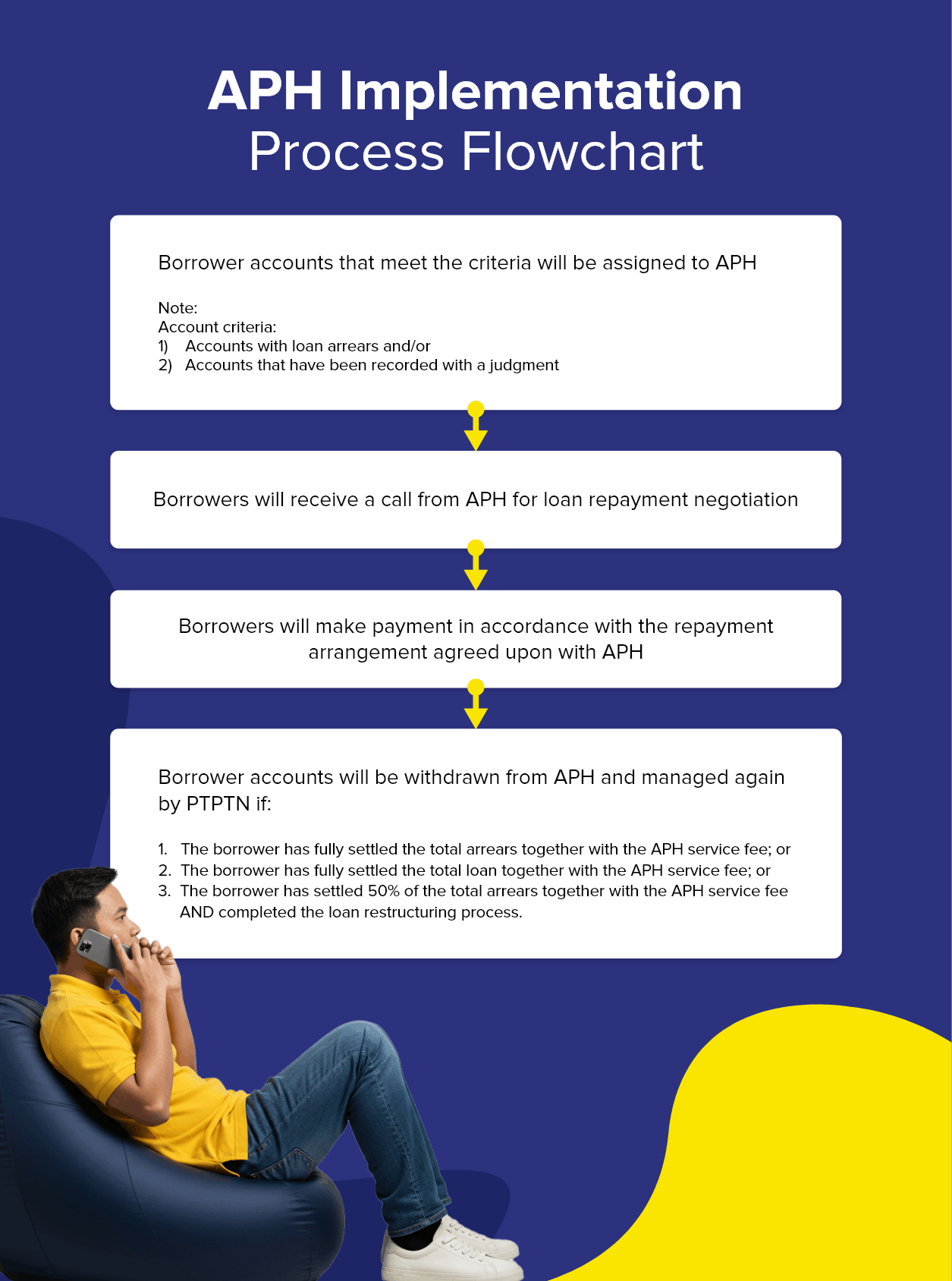
Flow Chart of the APH Implementation Process
This flow chart is provided to help borrowers better understand each step involved, offering a clearer overview of the APH implementation process carried out by PTPTN.
Conclusion
The implementation of APH by PTPTN is a firm and structured initiative to address the issue of defaulting borrowers, which affects the national education financing system. Through this appointment, PTPTN aims to enhance the effectiveness of loan collection in a professional manner without neglecting the welfare of borrowers.
Therefore, borrowers are strongly encouraged take proactive steps to fulfil their repayment obligations or contacting PTPTN for repayment consultations to avoid having their loan accounts referred to APH. Loan repayment is not only a legal obligation but also a moral responsibility towards ensuring the sustainability of higher education financing for future generations.